



In mechanical transmission systems, the gear reducer is an essential power transmission device that converts the motor's high-speed rotation into low speed and high torque to meet the speed and torque requirements of various machines. Common types of reducers include worm gear reducers, planetary reducers and harmonic reducers. Each has its own structural features, performance advantages and application scenarios, and each matches different types of motors. A deep understanding of the differences between these reducers and their suitable motor combinations is essential for optimizing mechanical system design and improving equipment operating efficiency.
I. Differences between the three types of gear reducers
(1) Structure and transmission principle
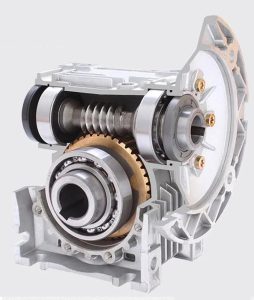
Worm gear reducer: mainly composed of a worm and a worm wheel. The worm is usually helical, while the worm wheel has helical teeth. When the worm rotates, it meshes with the worm wheel through the helical teeth, driving the worm wheel to rotate and achieving speed reduction. This type of transmission features multi-tooth meshing and a long contact line, allowing it to carry large loads.
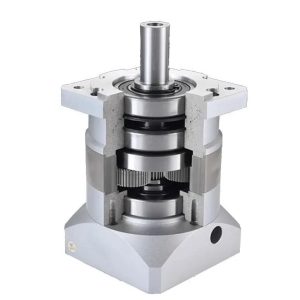
Planetary gear reducer: consists of a sun gear, planet gears, a ring gear and a planet carrier. The sun gear sits at the center and meshes with multiple planet gears, which in turn mesh with the ring gear. The planet carrier supports the planet gears and drives the output shaft. This multi-planet structure enables even power distribution and efficient speed reduction.
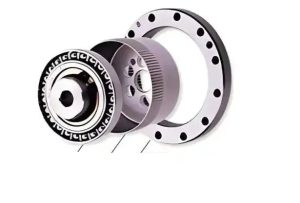
Harmonic gear reducer: mainly composed of a wave generator, a flexspline and a circular spline. The wave generator makes the flexspline deform elastically, and the teeth of the flexspline engage with those of the circular spline during deformation to achieve speed reduction. The transmission principle relies on the elastic deformation of the flexspline, resulting in a compact structure and a large reduction ratio.
(2) Performance characteristics
- Worm gear reducer: it has a self-locking function - when stopped, the worm wheel cannot drive the worm to rotate, making it particularly useful in scenarios that require prevention of back-driving. However, its transmission efficiency is relatively low, generally between 70% and 90%, and decreases further as the reduction ratio increases. In addition, its accuracy is moderate, making it suitable for applications where high precision is not required.
- Planetary gear reducer: it offers high transmission efficiency, usually above 90%, with some high-precision types being even more efficient. It provides high precision and high rigidity, enabling accurate transmission ratios to meet the needs of high-precision equipment. At the same time, it has high load capacity, a compact structure, small volume, light weight, and is easy to install and maintain.
- Harmonic gear reducer: it provides large reduction ratios - single-stage ratios can reach 30-320 - with extremely high precision and minimal backlash, meeting the requirements of applications with high precision and high dynamic performance. However, its load capacity is relatively small, the flexspline is prone to fatigue damage, its service life is shorter, and it requires high installation accuracy and favorable environmental conditions.
(3) Application scenarios
- Worm gear reducer: widely used in scenarios that require a self-locking function or where high transmission efficiency is not critical, such as lifting equipment, conveyors and packaging machinery. In such equipment, worm gear reducers provide stable power transmission and prevent load back-driving when stopped.
- Planetary gear reducer: suitable for various equipment requiring high-precision and high-efficiency transmission, such as CNC machines, robots and automated production lines. In CNC machines, planetary gear reducers provide precise tool feed, ensuring machining accuracy and surface quality. In robotics, they provide high-precision power for joint movement, enabling flexible and accurate actions.
- Harmonic gear reducer: mainly used in fields requiring extremely high precision and dynamic performance, such as aerospace, precision instruments and semiconductor manufacturing equipment. In aerospace, harmonic reducers meet the transmission needs of various precision mechanisms in aircraft. In semiconductor equipment, they provide high-precision power for wafer transfer and positioning, ensuring chip manufacturing quality.
II. Motor matching recommendations for the three types of reducers
(1) Worm gear reducer + motor
- Standard induction motor: in scenarios where transmission accuracy is not critical but a self-locking function or high torque output is required, matching a worm gear reducer with a standard induction motor is a cost-effective solution. For example, in simple conveying systems, the induction motor provides power and the worm gear reducer converts high-speed rotation into low-speed, high-torque motion while using its self-locking function to prevent material back-flow during stops.
- Variable-frequency motor: when stepless speed regulation is required, the worm gear reducer can be matched with a variable-frequency motor. By adjusting the motor speed through frequency variation and then reducing it through the worm gear reducer, the equipment speed can be precisely controlled to meet different process requirements.
(2) Planetary gear reducer + motor
- Servo motor: in CNC machines, robots and other equipment requiring high motion accuracy and dynamic response, planetary reducers are usually paired with servo motors. Servo motors provide high precision and fast response, enabling accurate speed and position control. The planetary reducer amplifies torque and reduces speed, increasing the system's transmission accuracy and rigidity and ensuring high-precision motion control.
- Stepper motor: for some automation equipment with moderate accuracy requirements but cost sensitivity - such as small automated production lines or 3D printers - matching a planetary reducer with a stepper motor is suitable. The stepper motor provides accurate incremental motion, while the planetary reducer optimizes the output performance, achieving relatively accurate motion at lower cost.
(3) Harmonic gear reducer + motor
- High-precision servo motor: in aerospace, precision instruments and other demanding fields, harmonic reducers are usually paired with high-precision servo motors. These motors provide ultra-accurate speed and position control, while harmonic reducers - with their high reduction ratios and extreme precision - further transmit motion accurately, achieving micron-level or even nanometer-level motion accuracy to meet high-end machining and measurement requirements.
- Torque motor: in some applications requiring direct drive and high precision, such as certain precision positioning systems, harmonic reducers are matched with torque motors. Torque motors provide low-speed, high-torque output, and harmonic reducers further optimize their output performance to achieve high-precision positioning and motion control while maintaining compactness and efficiency.
Worm gear, planetary and harmonic reducers differ significantly in structure, performance and application scenarios. In actual use, you should choose the right type of reducer based on the specific requirements for accuracy, efficiency and load capacity, and match it with a suitable motor to maximize the combined performance. With continuous technological advances, reducers and motors are also evolving, and more intelligent high-performance products will be applied across industries, bringing new opportunities for transformation and development in mechanical transmission systems.